Before the Proscenium: A Short History of the Thrust Stage
Explore the history of the thrust stage, from projecting platforms to modern theatres, and learn how its layout shapes sightlines, movement, and audience connection.
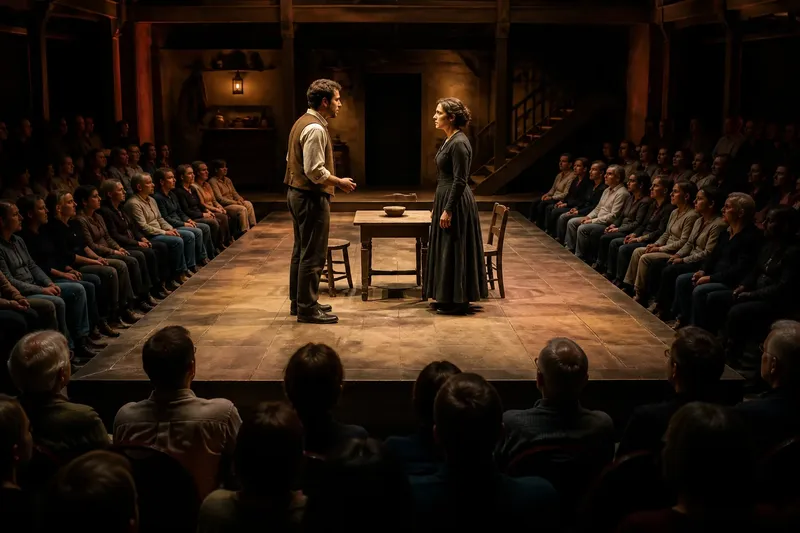
Where did audiences sit before the proscenium arch became a familiar feature of theatre? The history of the thrust stage has no single starting point: performers have repeatedly used platforms that bring the action into shared space. A thrust projects from a rear acting area toward the audience, with spectators along its sides and far end. That arrangement changes what each seat can see—and how actors use the room.
The thrust stage names a layout, not a single tradition
A thrust stage projects from a rear acting area into the auditorium. The audience sits along its sides and at its far end, usually on three sides. Its outline can vary, but the defining feature is the platform’s connection to a larger acting area behind it.
The word “thrust” describes this spatial arrangement, not a style of acting or a specific historical period. It is useful to distinguish a thrust from theatre in the round, where spectators surround the playing space. The two forms share some practical demands, but they offer different entrances, boundaries, and views.
Medieval performance took place in varied shared spaces
Medieval European drama appeared in churches, streets, and open spaces. Some outdoor performances used temporary platforms or pageant wagons to bring scenes to spectators in a town. Arrangements differed by event and place; there was no single medieval layout equivalent to the modern thrust stage.
A crowd near a temporary platform is not automatically an audience seated on three sides of a permanent stage. Medieval performance is a precedent for theatre beyond a fixed, front-facing room, but it does not establish a direct, unbroken line to today’s thrust theatres.
Renaissance playhouses made the projecting platform prominent
In England, public playhouses of the late sixteenth and early seventeenth centuries offer a clear example of a projecting platform. At the Globe Theatre in London, the stage extended into the yard, where some spectators stood, while others watched from galleries around the space. The platform connected to the stage building, and audiences encountered the action from several directions.
This arrangement differed from a modern thrust auditorium. The Globe’s yard was open to the sky, spectators occupied different levels, and the stage structure included a rear area and upper playing space. Still, the projecting platform made performance a shared event rather than a picture confined to one framed opening.
Across Europe, court entertainments and public playhouses developed their own arrangements. These should not be collapsed into one universal history. The narrower connection is that theatre makers repeatedly explored ways to bring performers close to spectators and use space beyond a single frontal view.
The proscenium framed the audience’s view
From the Renaissance onward, proscenium stages became an important design for court theatres and later public venues. A proscenium arch frames the acting area, and the audience generally watches from one side. Wings and scenery can conceal backstage activity, while perspective scenery can suggest depth beyond the stage opening.
A thrust offers a different arrangement. Spectators watch from the front and both sides, and some seats look across the platform toward other audience members. Actors must account for those directions: a line delivered toward one section may leave another watching a profile or a performer’s back.
A framed painting offers one preferred viewing angle; a table shared by people on three sides changes with each seat. The comparison is limited, since actors move and attention shifts, but it helps explain why a stage’s shape affects how a scene is arranged.
Modern theatres renewed interest in the thrust
The Shakespeare Memorial Theatre in Stratford-upon-Avon opened in 1932 with a thrust stage. The Royal Shakespeare Theatre, which replaced that building, opened in 1961 with a proscenium arrangement. During a major redevelopment, the theatre was reconfigured around a thrust stage and reopened in 2010.
This was not a simple return to an older form. Modern thrust theatres use contemporary structures, lighting, seating, and backstage systems. Their connection to earlier projecting platforms lies in the audience’s position around the action, not in identical architecture or performance practice.
What does the history of the thrust stage explain?
Can actors turn their backs on the audience?
Yes. A turn can serve the scene, but actors generally share important action across the room rather than play every moment toward one permanent front. Blocking can shift focus over time so different sections receive a clear view.
Does a thrust stage need minimal scenery?
No. Scenery can be substantial, but tall walls or deep units may block views from the sides. Designers consider what a piece looks like from several seating angles, along with the routes performers need through the space.
How is a thrust stage different from theatre in the round?
A thrust stage has spectators on three sides and usually connects to a rear acting area. Theatre in the round surrounds the playing space, so entrances and scenic boundaries must work differently.
How can I recognize a thrust stage?
Look for a platform extending into the auditorium, with seats along its sides and far end. If spectators face a stage through a framing arch from one side, the layout is proscenium instead.
A thrust stage makes its history visible in the room
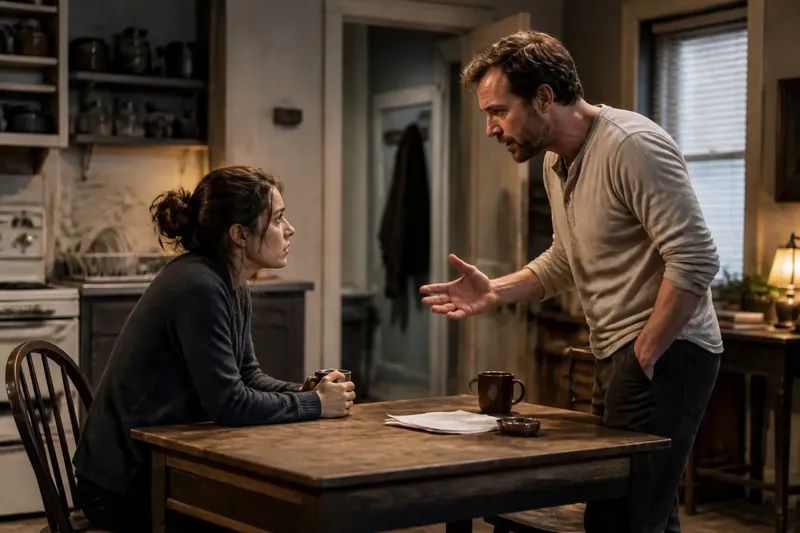
Say an invented production of a family dispute is being planned for a thrust stage. Two actors begin facing each other across a small table; one actor then circles the platform as the argument changes. The initial arrangement lets side seats see both faces. The movement shifts attention without asking either actor to address only the front, though spectators see different expressions at different moments rather than one uniform picture.
When you enter a theatre, notice where the stage projects, where the audience sits, and how the building frames or exposes the action. The history of the thrust stage is not a straight line from a medieval platform to a modern auditorium; it is a series of distinct choices about sharing a room. The seating plan remains a useful clue to those choices, even before the performance begins.