A First Read of a Play Script: Mark the Turns, Not Every Line
A first read of a play script becomes clearer when you mark the choices, discoveries, and refusals that redirect a scene without cluttering the page.
Where does the action of a play script veer off its expected course? On a first read, mark the choice, discovery, or refusal that redirects a scene—not every line that leads up to it. You will have a usable map of the play’s pressure points without turning the page into a thicket of pencil marks.
This approach suits an unfamiliar script you are preparing to discuss, write about, or develop in rehearsal. The aim is not to settle what every moment means. It is to notice how the playwright builds action: through decisions, withheld information, clashes of purpose, and consequences that arrive later.
Look for the action that changes the scene
A striking line is not automatically a turning point. Look instead for a playable change: a character makes an offer, blocks an attempt, reveals a fact, or chooses a new tactic. The change may be quiet, but it gives the other characters something different to answer.
Try a simple test: can the next exchange still happen in the same way if this moment disappears? If so, the moment may add texture or emphasis rather than redirect the scene. If its removal makes a choice confusing or a reaction feel unprepared, it deserves a mark.
For example, a courteous offer can become an obstacle once its terms are spoken aloud. A question can turn into an accusation when the speaker refuses to accept the answer. Read for concrete actions between people, not just changes in mood or volume.
Read through before annotating
On your first pass, follow the play without stopping to label every surprise. Notice who enters, what they appear to want, and which subjects characters avoid. If a question nags at you, jot it on a separate sheet and keep going.
That uninterrupted read helps you see how later scenes reshape earlier ones. A line that initially feels like a climax may become a setup; an evasive character may turn out to be protecting someone. Let the full sequence reach you before deciding where its important shifts occur.
When you finish, write a provisional sentence about the central action. For instance: “A family tries to keep a decision from the person it affects.” Treat that as a working description, not a verdict. The second read may show that the play is driven by a different conflict.
Use a few marks to keep the page legible
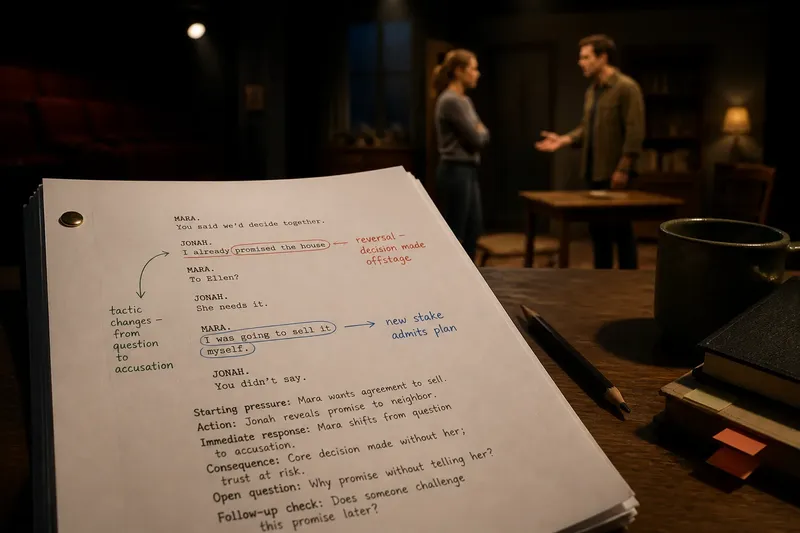
Choose a small set of symbols and give each a clear purpose. An arrow can flag a change in tactic, a circle can mark newly revealed information, and a question mark can note an unclear cause or consequence. Add a short margin note such as “refuses,” “names the terms,” or “learns the plan.”
Mark the decisive beat, not every line that prepares it. If several lines build toward a refusal, place the mark where the refusal lands. A margin crowded with underlining is like a map with every street highlighted: the route you need becomes harder to see.
For each marked moment, make a brief note of the following:
- Starting pressure: What does the character want, expect, or believe?
- Action: What do they say or do that redirects the exchange?
- Immediate response: What does another character do next?
- Consequence: What decision, conflict, or risk now has to be faced?
- Open question: What does the script leave uncertain?
- Follow-up check: If a later scene refers back to this moment, then connect the two in your notes; otherwise, leave the mark as a local shift.
Keep the notes compact. They should help you see how the playwright uses action and response, not become a scene-by-scene retelling.
Separate character tactics from what is at risk
A tactic is what a character tries to do: persuade, distract, bargain, threaten, or withdraw. Stakes are what may be lost or gained. Those elements can change together, but they are not interchangeable.
A character may keep pursuing the same goal while switching from charm to pressure. Or a new piece of information may raise the personal cost without changing what anyone is trying to accomplish. Distinguishing tactic from stakes helps you avoid treating every surprise as equally consequential.
Record whose risk changes. One character may fear public disgrace while another wants to preserve a private relationship. Their aims can collide even when both speak calmly. Notes that identify each person’s stake are more useful than a vague claim that “the tension rises.”
What should a first-read mark capture?
Should every entrance or exit get a mark?
Mark an entrance or exit if it changes who can act, what can be said, or how the others respond. If the movement does none of those things, track it only when you need it to follow the scene.
How can a quiet exchange redirect a scene?
Notice the action beneath the tone: a character may sidestep a question, make a refusal final, or end a negotiation with a soft answer. The response that follows can reveal whether the tactic worked.
What if a moment’s importance is unclear?
Put a light question mark beside it and continue. A later scene may connect it to a choice, or the uncertainty may remain part of the play’s design.
How many turning points belong in one scene?
There is no useful target number. A scene might center on one decisive choice, or its direction may emerge through several small exchanges; mark only what the text makes consequential.
Trace how scenes build the play’s action
After marking individual scenes, look at their sequence. Notice where one character’s decision forces another to act, where a new fact complicates an earlier plan, and where the play keeps a conflict unresolved. This is a way to follow the playwright’s construction, not a demand that every scene lead neatly to the next.
Imagine an invented scene: Mara arrives believing her brother has agreed to sell their late parent’s house. He tells her he has already promised it to a neighbor. On the page, Mara’s opening aim is to secure agreement; her brother’s disclosure redirects the exchange toward a decision made without her. She then admits she had planned to sell the house herself. That admission gives her a stake in the conflict and complicates the accusation she just made. The notes now identify two distinct actions—the disclosure and the admission—rather than treating the whole argument as one vague rise in tension.
Keep a transition separate from a change in action. A move to another room or a later time may leave the central conflict untouched. A single sentence may redirect that conflict while everyone stays put. Describe what a character does and how another responds; that gives you firmer ground than relying on a change of setting alone.
Use the marks to frame rehearsal and discussion
Return to a marked moment and separate what you can observe from what you infer. “She answers the accusation with a question” describes the text. “She wants to regain control” suggests a motive. Both can guide discussion, but keeping them distinct makes it easier to ask what the script supports and what remains open.
For rehearsal, connect a mark to a playable action: “What is he trying to get her to agree to here?” For a writing discussion, ask how the exchange prepares or complicates a later choice. Point to the relevant lines, then leave room for more than one interpretation.
A first read of a play script is useful when it helps you notice what characters do to one another, not when it produces a complete theory of the play. Keep the marks selective, name the action plainly, and save uncertain interpretations as questions. Your next read will have a sharper starting point.